You are here because time is short
Your exams are close. You might feel behind. That is normal and you are not alone.
This course gives you the most effective techniques for the time you have left.
Even a short run of focused, strategic revision can make a significant difference. The key word is strategic.
Short windows still work
Scientists have found that how you revise matters far more than how long. There are three approaches. Most students use the worst one.
Re-reading: what most students do
Re-reading is the most common revision method. Research rates it as low effectiveness. It feels productive but very little sticks.
Retrieval practice: test yourself
This works because your brain has to retrieve the information, not just recognise it. Research rates this as high effectiveness.
Spaced practice: spread it out
The gaps let your brain start forgetting. When you retrieve it again, the memory gets rebuilt stronger. Research rates this as high effectiveness.
See them compared over 7 days
Same topic. Same total study time. Three methods. Press the button below to see how much a student remembers across seven days. Watch the bars rise.
This course uses both techniques
That is the point.
Retrieve before you continue
You just read about three approaches. Close your eyes for ten seconds and try to recall them, then reveal the answers below.
- The revision method most students use
- The method that builds memory by effort
- The method that spreads study across days
- Re-reading (low effectiveness)
- Retrieval practice
- Spaced practice
If you got all three without looking, you just did retrieval practice. That is the effort that builds memory.
What is working memory?
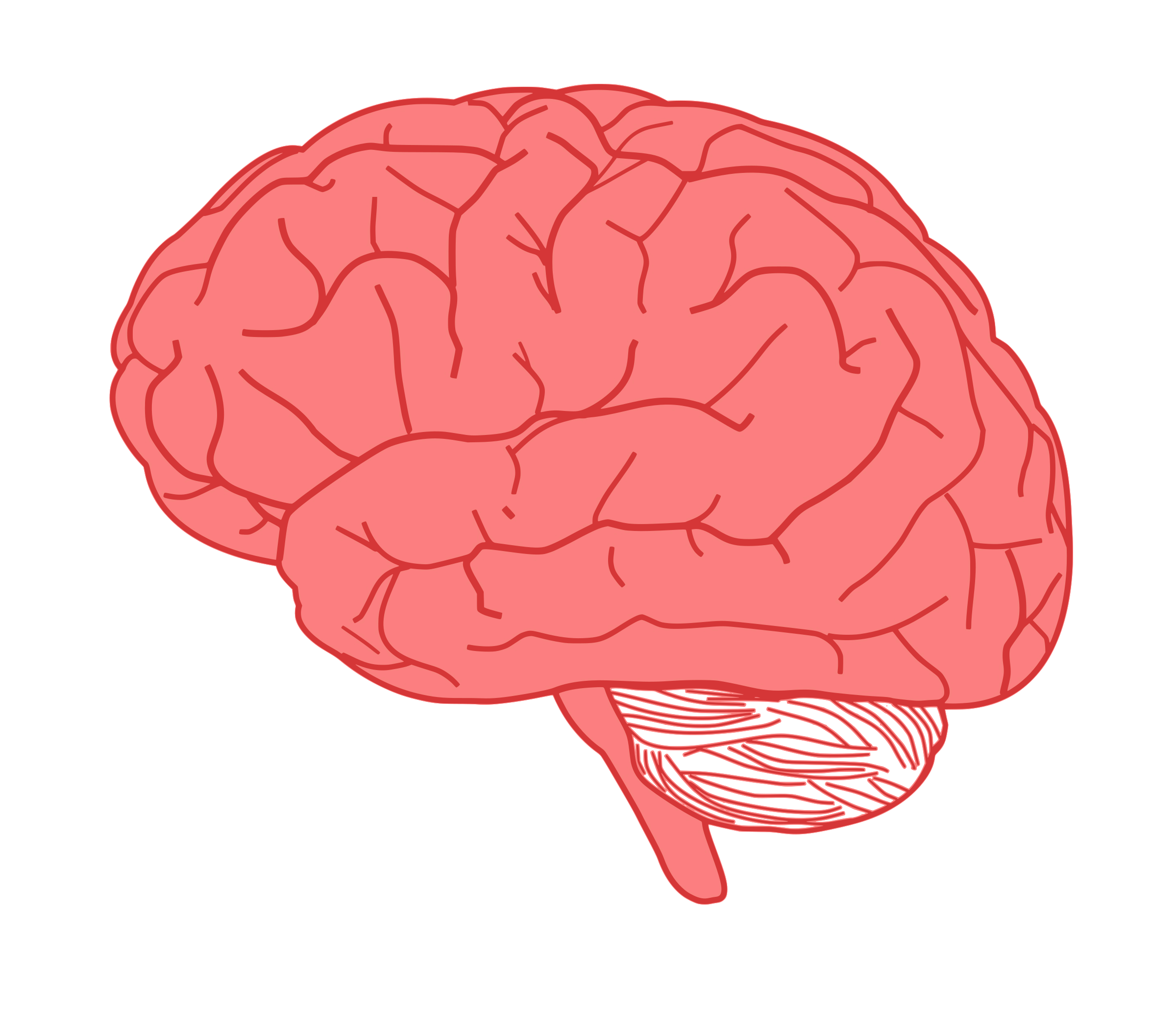
Your working memory is the part of your brain that holds what you are thinking about right now. Everything you read, hear or try to learn passes through it first.
The problem? It is tiny. It can only hold about 4 things at once.
Your working memory is a basket

Think of your working memory as a small basket. It can hold about 4 things at once. That is it. Four slots for whatever you are trying to learn right now.
Try to fill the basket
Tap each of the six facts to drop it into the basket. The basket only holds four — see what happens to the rest.
Your brain has a trick: schemas
When you already know a topic, your brain bundles related facts together into one package called a schema. Think of a subject you know well, like fractions.
You already know what numerators, denominators, equivalent fractions and simplifying are. Your brain has bundled them into one package. One slot instead of four.
Now there is room for more
Your fractions schema takes one slot, so three are free. Tap each of the three algebra facts and watch them all fit.
Start with what you partly know
Next: how to sort your topics.
You cannot revise everything equally
Doctors in emergency rooms use triage: sort patients by urgency, treat the ones where you can make the biggest difference first. Your revision needs the same approach. Sort every topic into one of three groups:
Know it well means a quick refresher only. Do not waste time perfecting what is already strong.
Nearly there is where your time is best spent. You have schemas for these topics, so your brain has room to learn new details. This is where you gain the most marks.
Do not know means be strategic. Can you learn enough to gain marks? If not, focus on amber. It is better to be solid on eight topics than shaky on twelve.
Meet Jane
How to sort:
- Read the topic name and Jane's note underneath.
- Decide how well she knows it using the key below.
- Tap the green, amber or red dot next to the topic.
Amber topics are the quickest wins. Jane already knows some of it, so revision unlocks marks fast. Focus here first.
All red — do not panic. Pick the topics that appear most often in past papers and focus your time there. Learning one topic well earns more marks than knowing a little about five. Strategic focus beats spreading thin.
All green — use your time for past papers under timed conditions. Knowing content is not the same as applying it under pressure. Most marks are lost on time management, misreading the question or weak structure, not missing facts.
Examiners come back to the same popular topics again and again. That means a lot of the marks come from a small part of what you've been taught. Get really good at those topics and you pick up marks fast. Module 2 shows you how to find them.
Two students, two weeks left
Jordan and Priya
How much time do you have?
Be honest. Write down what you are working with.
My situation right now
Three things to stop doing today
What this course covers
Five modules. Each gives you something to use straight away.
Module 1 (this one): Where you are. Triage.
Module 2: What to revise. Specs, past papers, 80/20.
Module 3: How to revise. Retrieval, spacing, subject techniques.
Module 4: Exam technique. Command words, planning, getting unstuck.
Module 5: Exam anxiety. Breathing, self-talk and exam day strategies.
Your first retrieval practice
Without scrolling back, write the three triage categories and what to do with each.
The three triage categories
What to take from this module
How you revise matters more than how long.
Triage your topics. Most time on amber (nearly there).
Stop re-reading. Test yourself instead.
Short sessions beat marathon cramming.
Before Module 2
- Write down every subject you are sitting.
- Sort topics into green, amber and red.
- Count your amber topics. That is your priority list.
Bring this list to Module 2.
Next: Module 2 helps you decide exactly what to revise.
Study techniques
Dunlosky et al. (2013) rated retrieval and spaced practice as "high utility" and re-reading as "low utility".
Retrieval practice
Roediger and Butler (2011) showed retrieval produces stronger memories than restudying. Agarwal, Nunes and Blunt (2021) reviewed 50 classroom experiments and found retrieval practice consistently improved learning across school years and subjects, including in students close to high-stakes exams.
Metacognition
The EEF (2018) emphasises students assessing their understanding and allocating time accordingly.
Working memory capacity
The "about four chunks" capacity figure for short-term working memory is from Cowan (2001), which reconsidered the older Miller (1956) figure of seven and argued that the actual mean capacity for young adults is closer to three to five meaningful items.
Cognitive load
Sweller (1988) established cognitive load theory and the role of schemas — how prior knowledge lets you treat several related items as a single chunk and so do more with the same working-memory budget.
References
Dunlosky, J. et al. (2013). Psychological Science in the Public Interest, 14(1), 4–58.
Roediger, H.L. III and Butler, A.C. (2011). Trends in Cognitive Sciences, 15(1), 20–27.
Agarwal, P.K., Nunes, L.D. and Blunt, J.R. (2021). Educational Psychology Review, 33, 1409–1453.
Education Endowment Foundation (2018). Metacognition and Self-regulated Learning.
Cowan, N. (2001). The magical number 4 in short-term memory. Behavioral and Brain Sciences, 24(1), 87–185.
Sweller, J. (1988). Cognitive Science, 12(2), 257–285.